This is not a flight manual, not factory documentation, and not a warm adventure story. It is the working notebook of an owner who built a Searey, upgraded it constantly, flew it since 2006, recovered a friend's aircraft from saltwater, and has spent 35 years in aircraft maintenance.
If you are looking for instruction on how to fly a Searey, input from a high-time Searey instructor, or a factory-authorized manual, you have come to the wrong place. This is a practical opening to building and/or flying one — written from the hangar floor, the lake, and the odd embarrassing beach.
It costs you nothing. The one request: put the effort in to send updates as you learn from your plane — particularly diagnosing problems unique to the Rotax engines and to the Searey itself. Corrections and new ideas are welcome — send them from the end of the book; say whether they are specific to a Classic or an LSA.
History & Hulls
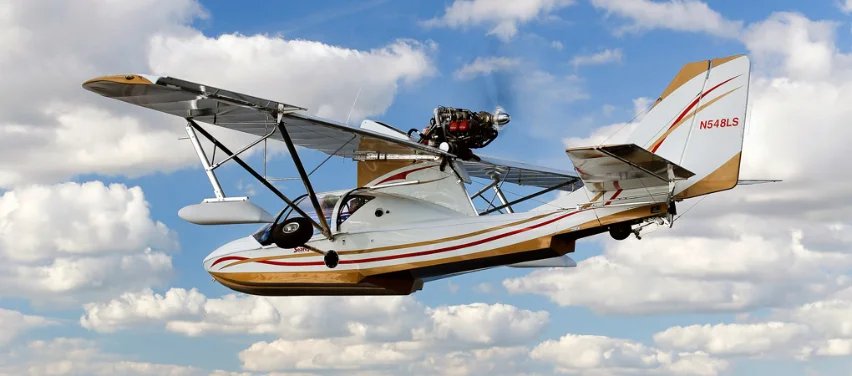
Starting as ultralights — Buccaneers and other names — the first Searey was produced about 1992, and the plane has been in constant evolutionary growth since. Searey #1 is being rebuilt at Clearwater Airpark as of this writing. The only true models are the Classic and the LSX/LSA (and arguably the single-seat Stingray); before the LSA, the community distinguished aircraft by hull type.
| Hull | Character | Watch for |
|---|---|---|
| A | Original, very light, flat bottom. Gets on the step quickly. | Careful attention lest the nose gets low — on glassy water drag rises fast and a nose-over can ensue. One OEM had quality issues; a tendency to delaminate. |
| B | Introduced fairly quickly: much stronger and heavier, larger V and far more buoyancy in the nose. | Takes bigger waves, keeps windowsills higher out of the water, much less tendency to suck the nose under. |
| C | Deeper V at the keel, more nose buoyancy, real storage under the nose deck. Fiberglass or carbon — carbon costs thousands more but saves 40–50 lbs. Used on the LSX/LSA. | Jokingly the "land-o-matic." Yes, it has been landed hands-off. No, that is not recommended. At least two makers of the carbon version. |
Community
The owners-access-only website carries over 10,000 postings with thousands of pictures and descriptions of every aspect of the airplane: open, frank discussion of technique, risk, building methods, upgrades, ideas and experience. You must be an owner to be invited, and there is no cost. There are also at least three Facebook groups; the older owners-only site sees less traffic than it did.
If you are building, join the private site on day one. You will find answers to simple and complex problems quickly, you will find a support group, and you may well find someone nearby who can help.
Adventures
Fly your 'Rey cross-country and there is likely another owner on the way who would be glad for a visit or, if needed, to act as a support resource. Owners have thousands of hours and hundreds of cross-countries. Seareys often travel in pairs, and several trips to Key West have gone with groups of five to eight aircraft. One pilot's list alone: the Bering Sea next to icebergs, Central and South America, the Philippines, Australia, the Caribbean, Raja Ampat, the entire perimeter of the US, Canada, New Zealand, Mexico.
Remember: this plane is about the trip, not getting there. A 16-hour day in a Rey is possible — it is also the one time gear position was nearly forgotten, and it becomes work. The Searey is about fun.
Field-repairable, demonstrated
- Land on a gator — it has happened — and she bounces off.
- Forgot to lower the gear for a land landing? Lift onto the gear and fly away.
- Buried a float hard enough that the breakaway let go and, by freak of nature, the float punched a hole in the wing? Tape over it and fly home for repair.
- One owner landed gear-down in the water far from shore; the windshield blasted out as the nose went under, the nose popped back up as it typically does, he hit the bilge pump, step-taxied, then flew at five feet — then home to replace windshield and avionics.
- Leaking gear leg boot? A roof vent stack boot from the big-box store swaps in 30 minutes in the field, and lasts years longer than the original.
Training
I am not an instructor and this is not training instruction. Before the factory closed there was a group approved as particularly qualified to train Searey pilots; type-specific training is strongly recommended. A flying boat of this size simply does not match the behavior of any other airplane, and a float rating will not make you safe in one.
CriticalIt is a low-power, low-momentum, light, high-thrust-line, high-drag, short-coupled aircraft. High- and low-time pilots have bought used Seareys, jumped in with zero type-specific instruction and flown for years without issue. One did the same and crashed on the first flight; several crashed within the first ten.
Taking a Searey up solo when you have never flown one — taildragger endorsement or not — is simply foolhardy. It is very rudder-centric; get slow, cross-controlled, nose high with water washing backwards in the hull, and recovery below a couple hundred feet is unlikely. Add an A or even a B hull and you increase the opportunities for embarrassment on the water.
Do not do full-stall landings on runways: the only shock absorber on your tailwheel is the boom tube. That is not an argument about which landing is superior — it is a request to be gentle on a part that is a real pain to replace.
Also take the Rotax iRMT class at RotaxIRMT.com. It is a week, it is worth it, and afterwards you can get the instructors' time when diagnosing issues later.
Emergencies
Water in the fuel
Have a water fuel filter in the fuel line, check it, and always keep a spare bowl packing in the plane. If your fuel tank vent line does not loop above the exterior vent fitting before it goes to the tank, any water washing over it outside ends up in your fuel tank instead of draining back out. That is a slow a-ha moment for almost every pilot it is mentioned to.
Know your glide
Flaps 1? 65 knots? Gross or light? Yours may glide 6:1 against a C-152's 9:1, because you have wires, floats and gear hanging in the breeze. Seareys also fly low, which gives you significantly less time to decide. The hull is tough: leaving the gear up will likely mean less damage going into an unknown field.
Parachute (BRS)
About $6,000 and roughly 40 lbs off your fuel and passenger capacity. The only known Searey use was an engine shutdown at the end of a runway over 90-foot Canadian trees — a bug in the fuel line, apparently no screen at the tank inlet — and the pilot survived with bashed shins. Most Seareys operate below the minimum altitude required for a BRS to work. You decide.
What the record says
Structural failure is effectively unheard of. Gear down in the water was the number one incident and almost never fatal — reduced sharply by gear warning systems and the mantra WUFF (wheels up for flying). The largest fatal category is the same as all of GA: loss of control at low altitude. Wing redesign with the LSX, strut plates and VGs cut stall/spin accidents significantly. A stall warning indicator is a great safety improvement.
TowingDead engine on a lake, drifting downwind tail first: all the paddling you and your passenger can manage will not turn the plane more than 30 degrees before you are tired. When a boat offers a tow, tell them nothing over 2 mph — then hold the rope in your hand so you can let go when they exceed it. Tie the rope to the plane and you will be replacing parts. Wrap it around your hand and you are either going skiing or losing skin. Boaters — even fellow seaplane pilots — do not understand towing forces until they are holding the rope.
Post-incident, still to be written up: when to inflate, engine off, quick-release harness, grab bag, avoiding the prop, staying with the plane, gators and other breakfast options, incident vs. accident, recovery, survival, EPIRB & ELT.
Maintenance
A request first. Very few people have deep Searey maintenance experience and are willing to work on other owners' aircraft, and we want them to stick around. They field many calls every week and generally answer them — which takes advantage of their good nature and costs them the work that pays their bills. Several of us send $100 by Venmo when asking advice. They say it is not necessary. They are also always happy to talk with me. Your $40–150K airplane is worth it, and so is their support.
Safety around the aircraft
- Working on the gear: I like my fingers, and I know someone who lost a thumb on the gear of a KC-135. Bent over the hull, working through the bulkhead, if the gear goes undercenter it is not just your hands — where are your feet relative to the chines? Who are you going to call, trapped in your own hangar?
- Always check wing strut-to-wing connection bolts. Torque them and expect them to move; the nuts are anchored to the forward spar.
- Do not go around tightening every bolt. The plane has many thin-walled tubes and you will simply deform them, which does nothing for safety. The tailwheel pivot point is notoriously overtightened; cotter keys on castellated nuts where you deem it appropriate.
- Bouncing over the water is the single most abusive thing that happens to your Searey short of crashing.
Salt: an expensive education
I live by Tampa and did a lot of Gulf landings my first year. It was a hoot, and very different from shorter lake waves. I would splash into my freshwater lake and hose the plane down. After a few months a lot of hardware showed rust, so I rinsed better. After a year I spent a lot of money and a ton of time replacing most of my badly rusted hardware — and stopped landing in salt. What I had failed to see was that the hull stringer-to-bulkhead bolts were never getting flushed clean. A couple of years later I removed them and found them severely compromised, in an area that is a total pain to work. I rethought how the stringers attach: a pair of aluminum angle plates, and the vertical bolt through the bulkhead shifted a couple of inches away from the actuator. Much stronger.
Additions to the factory annual checklist
- Mark the tank in 5-gallon increments so you can check it visually on the ground.
- Carb cables for throttle and choke (enriching circuit) — watch a short video on twist-welding cables here. Spray anti-corrosion lube (ACF-50) on both carb springs frequently; they rust badly without it and are expensive.
- A 5" round marine plastic threaded access port beside the boom tube, behind the rear engine support on the turtledeck, makes inspecting the girdle that attaches the rear engine support to the boom tube easy. Trim the threaded ring to fit against the boom tube.
- Fuel tank vent: route it up first, like your static line vent.
Windshields
Many owners have replaced windshields because of cleaners that caused hazing — even soap and water hurts if the soap has citrus in it. If you must replace one, a 4x8' sheet of UV Lexan (not Plexiglas) will just barely yield two; use the old one as a template. Slightly oversize the rivet holes and do not fully pull the rivets: snug them and cut off the mandrel, so the panel can move a little with temperature. Otherwise the holes grow cracks. And no burrs before riveting.
Tailwheel O-rings
The rubber O-rings that tension the castering system need occasional replacement. Per JR: take the cable off the outer end, slide the O-ring as far as you can by hand, then use a small pick or flat-blade screwdriver to walk it up — they stretch, and will go over the nut as well. Make sure it sits past the hook that stops it sliding back off. Reconnect the cable: the left cable rotated one full turn counter-clockwise before inserting the bolt, the right one full turn clockwise. Without that pre-twist the loops can snag the tailwheel as it moves up and down.
Tools & Flight Spares
This is a simple plane to build. You do not need to weld and you do not need to be a composites person — though you may decide to mix a little resin and lay more glass tape on the stringers. The fabric covering is the scary part for most builders; afterwards they say it was fun and not hard at all.
Shop chemicals
- ACF-50 anti-corrosion
- NON-CHLORINATED brake cleaner spray
- CRC QD electronic cleaner for inside connectors
- Overspray or chemicals on your Lexan is an expensive error.
Hangar tools
- Reamers from Aircraft Spruce: 3/16, ¼, 5/16, 3/8
- Dual pressure gauges for carb sync
- Compression test kit
- Oil purge kit
Flying tool bag
10mm for the 914 hard fuel line to the carb, and whatever your battery bolt is (frequently 10mm). Engine operator's and repair manuals on ForeFlight or a hard copy on the iPad.
Rags, ziplocks, zip ties, standard and adjustable wrenches, sockets and drivers, spark plug socket and plugs, oil filter, fuel filter, water separator gasket, inner tube, cable crimper and crimps, wire stripper, wire and cable, headlamp, rubber and work gloves, vise grips, swages, tape and solder, prop protractor, safety wire pliers, carb balance tool, remote starter trigger to bypass the ignition, pop rivets and riveter, drill and bits, air cleaner soap and oil, spring clamp pliers, hex wrenches, WD-40.
Flight spares
- Wing float breakaway parts, pre-drilled, plus the tools to fit them
- Duct tape for wings or hull
- Spare VGs and super glue — check the reg, but lose 3 VGs and you likely cannot fly legally
- O-ring for the water separator
- 10' para cord: wing tie-down, tailwheel when a cable breaks away, or holding overcenter after a gear incident
- Spare landing gear relay
- Lightweight chocks, sand screw anchor or empty sand bags for beaching
OilIf you are away from home without oil, do not use airplane oil — the gearbox needs the right stuff. Look it up yourself; I believe 10W-40 API-SG, where the SG is what keeps your gears alive. On MOGAS only, one report says synthetic motorcycle oil is fine. On 100LL you really want Aeroshell Sport 4, which I believe keeps the lead in suspension better. I found a motorcycle dealership carrying it while on a cross-country.
Upgrades
Some of these are not compatible with others — with an A hull, good luck getting the 25-gallon tank in there. List what you want and think hard about order. If you ever want to upgrade the fuel tank, do it while the hull is off, or you get to remove the bulkhead. The bulkhead is connected to everything in the plane, including your wallet.
Buying a B hull, I would plan to replace the hull, replace the tank, upgrade the bulkhead and put the short doubler inside the boom tube in one shot. Almost everything else can be done piecemeal afterwards — and besides, after those three you cannot afford anything else until the better half releases your wallet again. In my opinion the short doubler is not needed if you are doing wheel landings and not operating off very rough strips.
Were I to do it again, every fuel tank penetration would come from the top. Nothing on the bottom: bottom threads are very hard to reach, the lines and fittings sit in water, and there is no reason to add leaks and hassle near the bulkhead.
Do these first
- Bulkhead upgrade — everyone should do this, or expect a gear collapse at some point.
- Gear warning system — everyone should have one. Fleet history before and after speaks for itself; experience does not matter.
Structure
- Split aluminum stick supports
- Split aluminum rudder supports
- VGs; strut plates
- Turtledeck arch sandwich
- Larger AN bolts at wing and strut attachments
- Upgraded wing front attachment (to meet LSA standards, not because of failures)
- Horizontal stab & trim from Classic to LSX; V-stab bracing
- 3rd hinges on elevators and rudder — with a diagonal tube from below the middle hinge to the bottom rudder corner for lifting the tail. Lifting by the tail is needed more than you think.
Cockpit & systems
- LSX seat pans for Classics
- Love Hatch or Cobra Kayak hatch
- Frise aileron mod for Classics
- Canopies — two per sheet; if you are tall, raise the top rail of the slider a couple of inches (needs a new windshield and support)
- Throttle forward; brake reservoir
- Parking brake — be very sure it is off going from water to runway. You will not nose over, but taxiing is hard.
- Gear boot replaced with a roof vent boot: Lowes item 53196, model 14052, Oatey, $29. If anyone finds an equally good elevator boot, please share.
- Gear oversleeve by Axle rather than an insert on early Classics
Weight & balance
Battery shelf at the nose gives the best CG — if you must add ballast, move the battery first. The typical Odyssey PC680 is 12 lbs, AGM so it can lie on its side, and mine sits within 2" of the tip of the nose on a ¼" ply shelf with a vertical dowel supporting the center, glassed in.
With a Dynon EFIS you can add stall warning with their probe, or make your own from hollow aluminum pipe, two pitot tubes and a glob of epoxy — copied from the Searey guy we call The Professor.
Replace the original flat-bottom fuel tank if you still have one; most of the fleet has, and there are at least four versions of the plastic tank. In my opinion we still need someone willing to weld up proper tanks — I would be happy to discuss optimizing one for the Searey.
Building & Rebuilding
Building is fun. Keep it fun. Two things get the job finished: touch the plane every day — do something, even just ordering a part — and join the private owners-only site. I took three calendar years to get mine in the air.
Fabric is not hard. I have done it with the Polyfiber method and it works great; I have also used the non-stinky method and recommend it. Painting is tedious — careful painters get very good results, and if you are not patient and detail-oriented, hire it out. The paint job will be in your face for years. Wish I had, although next time I will do it myself, because I usually get it right on the second try and perfect on the third.
Bringing a used Searey as close to an LSX as possible — worth doing, because the incremental improvements add up to a truly better airplane — means two areas first:
- Engine and prop must be perfect. Do not skimp and do not let an A&P who is not intimately familiar with the Rotax 912 touch your engine. I have rebuilt many small engines and spent a dozen years as a USAF heavy turboprop mechanic; the engine is rock solid only if cared for correctly.
- Hull, bulkhead, fuel tank. With an A or B hull you may want to swap to C — and that is the moment to remove the flat-bottom 18-gallon tank and upgrade the bulkhead. Expensive all at once; you will know it was the right call. Tank replacement requires hull or bulkhead removal, and both are a pain.
Buying a partially built kit? Read the next chapter first.
Buying Used
The 914 turbo is noticeably more powerful than the 912ULS — I have had 80, 100 and 115 hp — but it brings a lot more complexity and maintenance. If you fly for fun and are not climbing over tall mountains, the 912ULS is a great, reliable, easier-to-diagnose engine. Have your engine (95% are Rotax 912 or 914) checked by a pro.
Pre-purchase inspection list
| Check | What you are looking for |
|---|---|
| A hull | Delamination. Check carefully. |
| C hull stringers | Stringers glassed inside the hull should be wood. Foam lets the bolt holes attaching the inner frame wallow out under wave beatings — a wave smack can easily generate 6 G momentarily, and hull stringer to frame is the first connection point. Ask permission to poke a needle in: past the thin glass, if it goes in, it is foam. Replacement is neither hard nor expensive. (One person says all C hulls have foam stringers — can anyone confirm?) |
| Vertical stab, if over 5 years old | Look up the tube just above the tailwheel for three concentric tubes for the rear post. Only two means replacing the vertical stab — you cannot jam #3 up there. You also absolutely want the extra V-stab brace: it moves the bending moment farther up, shortens it and greatly strengthens the whole stab. Every time you step on the rudder you bend the V-stab right where it exits the boom tube. Cracks have been found there, and they are very hard to see without pulling the stab. |
| Bulkhead | Vertical round tubes at the corners mean the older style (the LSX bulkhead is much heavier and stronger). Not bad in itself — but check the round supports carefully for cracks where the landing gear leg pivots on its bolt. |
| Fuel tank | A flat bottom is the original: fine, but 18 gallons with 3 unusable. At 5 gph and an hour of bingo fuel, a prudent pilot is limited to just over 2 hours per tank. |
| Boom tube at the rear engine support | Where the rear (30°) engine support meets the boom tube, a very hard landing can dent it. Only visible looking up from the tail with a camera or a very strong light. Any sign of boom tube injury is critical. |
After Your Purchase
- Registration can take months. Do it right the first time or you go in circles with an FAA that does not care whether you ever fly. Renew it on schedule and log it.
- Register your 406 MHz ELT with NOAA — free, good for two years. Replace the batteries on schedule (I believe every 5 years, or after use) and update the maintenance log.
- Make sure the transponder is working correctly and log when it was tested.
- Take the Lockwood engine class at RotaxIRMT.com. A week, worth your time and money.
Lessons Learned
Otherwise known as stupid stunts. AMHIK — ask me how I know.
Gear not perfect
After a hard landing, or without the upgraded bulkhead, inspect the gear mechanism regularly. Gear collapses from bent vertical tubes in the original bulkhead probably outnumbered the fleet — more than one per plane. A collapse is not the end of the world, and with a rubber keel guard on the long flat part of the keel it does little damage beyond ego.
But sliding along a runway on your hull, there is zero chance of powering up and rotating off to escape the humiliation: the hull cannot pivot on the rear of the step and the wing AOA is strongly negative. You will just grind off more composite. I am glad someone in the fleet already tried, because unbelievably that knowledge can flash through your brain just as you realize the gear is not where it should be. The slide without extra throttle is exactly 320 feet. Swallow hard, call the runway closed, and borrow a jack and a piece of wood to spread the load under the hull. Four guys and a jack will get you back on your wheels — use your para cord to keep the overcenter overcenter as you taxi off, and do not lose a hand doing it.
Getting out on the water
Most of us are too old to haul our carcass over the canopy sill. Put the gear down first — and if you have a parking brake, lock the wheels so the tire makes an easier step.
Water separator, floating
Can you even reach it while afloat? Think about that during the build. Open it, dump it, go to reinstall the bowl — not going: the packing swelled the moment it hit air. Then you are drifting backwards, downwind, paddle useless in anything over 2 knots.
Where a tow hooks on
The bow eye? Not if you like it attached to your plane. The gear? Only locked down — up, they are not supported against twisting. I held the rope in my hand and let go several times before the boater understood how slow he had to go: basically idle, in gear.
Prop tape and water
Nickel leading edges are common on water planes because water delaminates most props. If you use prop tape and ever sense a loss of thrust, stop now — getting airborne is very unwise. I could not make enough thrust to get on the step after tape peeled back slightly near a tip. I heard the pitch change, found a beach, peeled the tape off and flew home. It is hard to believe how much thrust a little lifted tape costs.
Open canopies, Florida heat
Slip down to the lake and the fleece jacket in the back gets caught in the sideways airflow. You watch it go out the window just before you hear the prop eat it — $600 to Warp to renew the prop. Same goes for a passenger's baseball hat when they lean out for the picture.
Landing on the beach
They are never deserted. The Karen a mile away calls 911 and ten minutes later five agitated cops are convinced landing on an empty beach is a crime. While you deal with them the sand dries and softens, so you take off rattled and angry across a very different beach than you landed on. Soft-field technique matters a lot when the tailwheel is dragging and the water's edge is coming up fast. And do not — do not — turn on your bilge pump as you pass over them.
Cockpit hazards
Copilot stick: you do not want a passenger standing on it. Stick supports are not made for walking — feel for cracks underneath. A small toolbox on the floor slides under the stick when you pitch up and locks it; use trim while you figure it out, then the bilge pump afterwards.
Low flying
I am not worried about hitting a Cessna at 100 feet. I am worried about seagulls, pelicans, cell towers and power lines. Wire strikes: once lucky, twice dead. Flying below 50 feet all the time is a bold pilot. Impressing your friends by flying into a cove — you can guess what happened.
Water, step turns, glassy water
Slow step turns put a lot of water through your prop. Going from riffled water to glass around a corner on a lake will get your attention in a C hull and may be expensive in a B. Pump your bilge — are you ready for a rearward-moving CG at 5 feet AGL? Popped a wing float support and the wing is in the water? If solo, climb into the opposite seat to balance, close the canopy, bilge on. (Is your replacement breakaway in the plane?)
Structure and stunts
Fiberglass will not support the engine — if you are messing with the front or rear vertical supports for the engine support tube, put the engine on a sling. Stall/spin risk rises with flying wires and "upgrades": we have seen truly shocking structural mods, and some ended badly. And "I'm not ready to fly, I'll just step-taxi my new bird" was my first, very unintended flight.
Jet skis & marine police
Give jet skis room; one underflew me during landing and the teen had no idea I could not see him. Carry a copy of the seaplane rules that override normal boat rules (see SPA) for beach landings, swamping, PFD and fire extinguisher questions — and a gentle reminder that courtesy with police is always the best place to start.
Engines
Fuel pumps (914)
The 914 needs two electric pumps because the OEM mechanical pump does not provide enough pressure or volume. The Pierburg E1F has changed version several times, with the latest above $500 each and you need two: 27 PSI, 95 L/h (about 25 gph), set up in parallel with one-way check valves.
Oil
Filter change and tank vacuum only: no purge needed. If oil lines are opened, use a pressure purge kit (Lockwood TL912PPK-U) so the hydraulic valves do not collapse. Find the correct purge fittings — they may vary by engine.
Sprag vs. slipper clutch
The sprag clutch engages the starter motor; kick-back on start damages it. The slipper clutch (officially the overload clutch) protects the crank from destructive shock loads such as a prop strike. Early high-compression 912ULS engines failed slipper clutches early because of the start jolt; ignition timing was retarded at start via an ignition box mod to fix it. As of 2026 a sprag clutch is about $600 in parts — and I have the giant crank nut wrench if you do it yourself.
Rough running
- Check the choke (enriching circuit) is actually off at each carb — sometimes the cable end, sometimes a broken wire inside the sleeve that sticks.
- Check the spark plugs. Changing plugs frequently genuinely helps.
Turbo misbehaving
Disconnect the turbo cable and check it moves freely in the sleeve. I spent many hours and hundreds of dollars before finding a broken strand where the sleeve was bent too tight. Away from home with too much boost at far too low RPM — which is bad — people have gotten home using safety wire and the bleed valve spring to hold the bleed valve slightly open, making some boost but not max. I do not recommend it; I just know it has been done.
Housekeeping
- 5-year rubber change: capture the list from Angel and keep part numbers.
- Check the coolant cap for correct pressure; check whether your dipstick top is square or oval.
- Wash the engine with Dawn — no alkaline or petroleum-based solvents.
- Carb sync kits for a Searey need extra-long hoses to reach the cabin. A threaded adjuster for each cable just behind the throttle would make sync easy; you can do it by ear once you know the engine.
- Join RFSC for good maintenance videos.
- Build a remote starter setup so you can spin the prop with the ignition off and key out — alligator clips, spring-loaded to off.
Props
| Prop | Notes |
|---|---|
| Warp | Most common prop on the Searey. Must use a crush plate. Retorque the bolts. In my opinion, best for the money. |
| Catto | Bolts and crush plate; for Catto hardware go to Saber Manufacturing, 817-326-6293. |
| IVO | Moment of inertia is out of spec for the Rotax. Many still use them; it may cause early gearbox failure — I believe via the sprag clutch. |
| AirMaster | In-flight adjustable and reversible, about $10K. Reverse does not allow steering — it keeps you from hitting the dock when you botch the approach with a tailwind. |
I have used IVO 2-blade, IVO 3-blade, Catto, Warp and AirMaster. There is also a French prop that at least one Searey owner likes.
Electrical & Avionics
Wiring the boat
- AC 43.13-1A and -2A from the Government Printing Office is the airframe and powerplant bible.
- Build a dual-purpose shelf: electrical, plus support for the nose deck.
- All aircraft-grade connectors, plugs and wire; look at lightweight split loom.
- Klixon breakers are the kind you can pull out to turn off.
- The ACI power buss is an electronic breaker board made specifically for the Searey, with a few revisions; ACI also makes boards for the electric gear, flap selector buttons and gear warning system — see FlyingSafer.com. Effectively a one-man shop.
- If your regulator/rectifier fails, note they are not Rotax OEM — they are motorcycle units and have not been reliable in our fleet. Consider a BandC.com unit (about $250): adjustable voltage, better built by all accounts.
Troubleshooting starts at ground
In the Searey even more than other aircraft, grounding is the best starting point — it is a bolt-together rather than welded frame, and the water environment adds corrosion. Never use the frame as ground. Use heavy gauge cable to ground buses.
Charging system failing? You will not know until you start losing radios, unless you have a voltmeter — not an ammeter. Don't ask me how I know. On the ground, everything off and no charger connected, record exact voltage across the battery terminals. Chock and tie down, competent pilot in the seat, run to 3500–4000 RPM: voltage across the terminals should be higher than the first reading. If not, the R/R may be bad. Mine still failed after replacing the R/R — it turned out to be the generator side of the split master switch.
Avionics
Everything from steam gauges to Dynon IFR is out there. Since this is a plane made for splashing and dashing around lakes in good weather, steam gauges are very practical. The fancy stuff you really do want is a gear warning system; an angle-of-attack system is a great safety factor. A very good noise-cancelling headset makes you and your passenger far more comfortable — the engine is right behind your head. With a carbon fiber hull, remember your antenna will not work through it, so it goes outside.
Landing Gear, Generation By Generation
The original gear was a manual pull bar in front of the throttle. Once the fleet moved to larger, more buoyant tires it became a bear to pull the tires down far enough to get past the over-center locks. Next came electric-hydraulic actuation, eventually replaced with more reliable and lighter electric actuators after a Canadian owner showed his design.
The over-center locks were very sensitive to any bending of the vertical support tubes on the original bulkhead, which led to a plethora of gear collapses. One member's over-center lock went a long way toward reducing them, but ultimately the upgraded bulkhead from the LSA re-engineering fixed it.
The C hull's deeper V required longer gear legs. Wheel attachment changed a couple of times; the current arrangement is an oversleeve that slides over the bottom of the leg with a flat plate welded vertically at its end, matched by a plate on the axle — toe-in and wheel lean adjust with washers between the plates. LSA drop testing added an angled cut on another oversleeve at the gear pivot, allowing a little bend at max load. The drop test video is very impressive.
The tailwheel has changed a few times too, but no factory tailwheel has a shock absorber other than the boom tube itself — so tailwheel landings are not recommended.
Hangars, Docks & Insurance
A backyard hangar that survived two Cat 3s
We live on a lake, so I built my own: 6x6 pressure-treated posts sunk 4 feet into the ground with concrete at the four corners, the rest of the frame exclusively pool cage aluminum. Solid corrugated metal on the back wall, clear corrugated plastic gable ends for light, and originally a smoked corrugated plastic roof — which hardened in the Florida sun and lost several panels in a Cat 3 hurricane. Replaced with corrugated metal, it survived a high Cat 3 in 2024. The front is a rolling curtain split in the middle; the floor is 18" pavers.
Floating docks
Several folks ask about keeping a plane on a floating dock and driving up onto it; some have used a jet-ski-style plan. The obvious risks: weather exposure, wave action, and a hull design that makes sliding back off hard because the back of the keel wants to catch. At least one person built a dock he could drive onto and back off with the wheels down. When I built a temporary ramp over a seawall elsewhere, we made it much too narrow — you want at least 2 feet past each wheel, and probably bumpers. Running a wheel off the side would be a bad day. Experience reports welcome.
Insurance
My understanding is that you will be required to have type-specific training from a Searey Approved Training Center. Someone with real experience here needs to write this chapter.
Kit & Resources
What I carry
- Inflatable preserver with pockets — spare Searey key, PLB and a tiny survival kit in the two pockets, and a knife on a lanyard inside the folded-up part that inflates.
- Seatbelts must have quick release and a shoulder harness: the harness keeps you conscious when you land gear-down, the quick release keeps you from drowning.
- PLB — best deal appears to be Ocean Signal at Sporty's.
- iPad with ForeFlight; a ScotteVest fits a full-size iPad in an inside pocket — warm, light, well made, a zillion pockets.
- GoPro, or for about $75 a dual-lens in-car camera that captures the view ahead and the pilot at once.
- Water shoes, hat, sunglasses and spare glasses for when you drop a pair in the lake away from home.
- Keys on a floatie. It is only a matter of time.
- Collapsible paddle — knowing that in any wind, any paddle is worthless in a Searey: you are going downwind backwards, period.
- A tow rope, plane-end always held by hand. Otherwise something is going to bend, I guarantee it — and do not wrap it around your hand if you value your skin.
- Alaska bush gear fuel bladder.
Odds and ends
Best muffler: the Titan is too noisy; the newer muffler with the can on top — it looks like an old-fashioned car muffler — is much quieter.
Events of note
- Into the flight levels (before ADS-B)
- Around the world — Mike Smith, Voyage of the Southern Sun
- An oceangoing adventure: a Searey on a yacht
- Fly-ins
- Travels with Puff — Richard Bach, same author as Jonathan Livingston Seagull
Help Wanted
These are the areas I would love someone to work on. If enough input arrives — tall tales, lessons learned, maintenance tips, or filling in the open items — the first-person introduction comes out and this becomes a book from the Searey old-timers. I would be happy to have one or two other authors, but I will not open it to a large audience; I cannot be bothered moderating the inevitable disagreements over trivial stuff.
- Fly-ins
- Owners list — John Dunlop kept this going for years
- Owners' sites — there is an owners-only site with little traffic now, plus at least three Facebook groups
- Checklists — where the originals are stored and how to update them. If you have the code for your Dynon checklists, please share; same for ForeFlight or other tools.
- Post-incident procedures, insurance experience, floating dock experience, electrical troubleshooting stories
- Someone willing to weld up proper fuel tanks